
The erosion of American Dream was not sudden, it happened gradually over time. Until the 1980s the wages of American Workers tracked productivity growth closely, but since then the share of productivity growth that has cumulatively accrued to the average American worker has been meagre compared to the share that accrued to corporate profits.
What has occurred, albeit slowly, is the emergence of wealth gaps in society. And slowly those wealth gaps have created resentment in different factions of society. Like diseases that present with different symptoms, these gaps have manifestations too: growing polarization, rise of populism, declining fertility rate, pessimistic youth that sees a bleak future, declining standards of living, the “hollowing out of the American middle class”, worsening mental health, emergence of trillion-dollar monopolies and oligopolies, and the list goes on. This was intensified further by misallocation of capital by governments with policies, that in the name of sound economics, further intensified this divide.
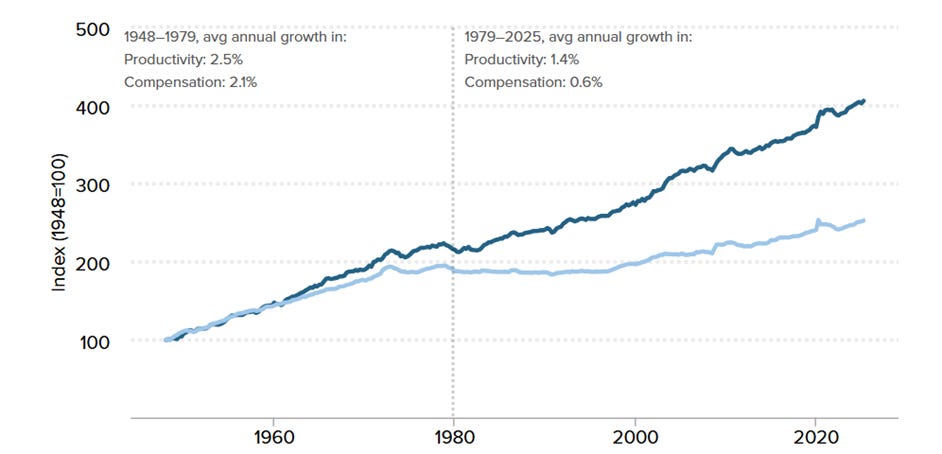
Productivity growth and hourly compensation growth, 1948–2025. (Source: Economic Policy Institute, EPI.org)
The trend that started in 1980s further entrenched itself with systematic destruction of unions and other bodies representing the interests of the workers, labeling of such policies as “socialism” by interest groups and their political henchmen. We then saw the changing definition of free market capitalism to reflect what is essentially “corporate socialism”. And while all this happened, the American Dream withered.
The productivity and wage gap continued to widen, but the blow was softened by a traditional American household transitioning from a single to a dual income household. Over time, the dual-income household concept has transitioned from a societal norm to a societal need. While the average American workers perhaps never had a chance to pause, and think, “What is the next sacrifice we must make?”. Unbeknownst to them, this is already starting to reflect in the fertility rate where American people are forming less families, having fewer children, becoming perpetual renters, accepting declining living standards, living with worsening mental health, paying more for healthcare, groceries, education, and leading increasingly dissatisfied lives. We need to ask ourselves where this will lead to, as a society?
A note the kind of socialism that they do not talk about on the TV: When policies are directed at swindling larger parts of productivity away from those whose labor bears it, why is it that we use the word corporate socialism so sparsely? This phenomena has become so entrenched in our society that at times the stock market reacts positively when companies announce layoffs. Should we, as a society pause, and talk about the human cost of a layoff?
Can the society heal? The first steps to healing, would be a wider acknowledgement that something, indeed, is wrong and talking about it. Then, making it a moral responsibility to educate ourselves about the reasons why this generation feels so much less secure than their parents. It would require being being open minded to ideas and wanting to seek knowledge.
We also need to be actively calling out the leaders that gaslight us as a society (remember “vibe cession”?), and try to have us misdirect our anger at each other while distracting us from knowing the truth. The answers lie in actively looking for what policies are continuing to lead to the demise of what is left of the American Dream. The dream that belongs to all Americans, not just the select few. Election after election, party after party has only shown us that the change is not going to come from outside, and it has to come from within.
“What America do we want to leave for the next generation?” I would prefer a country where the American dream is alive, the youth once again has eyes brimming with optimism, where people want to create families and raise a beautiful generation of future citizens to lead the world like we have for decades.
“Life, Liberty, and the pursuit of happiness.”
Disclaimer: The information contained herein is provided solely for informational, educational, and entertainment purposes and does not constitute financial, investment, legal, or tax advice. I am not a licensed financial advisor, investment professional, or fiduciary, and no portion of this material should be construed as such. All statements, analyses, and opinions expressed are exclusively my own and do not reflect the views, positions, or policies of any organization, employer, or institution with which I am presently or have been previously affiliated. The content does not constitute an offer, solicitation, or recommendation to buy or sell any security, financial instrument, or investment strategy. Any actions taken based on the information provided are undertaken at your own risk. You are strongly advised to seek the counsel of a qualified financial or legal professional before making any investment or financial decision. The material herein represents my independent research and analysis. All rights reserved.